
MIM Material Selection Guide: Diverse Options for High Strength and Special Operating Conditions
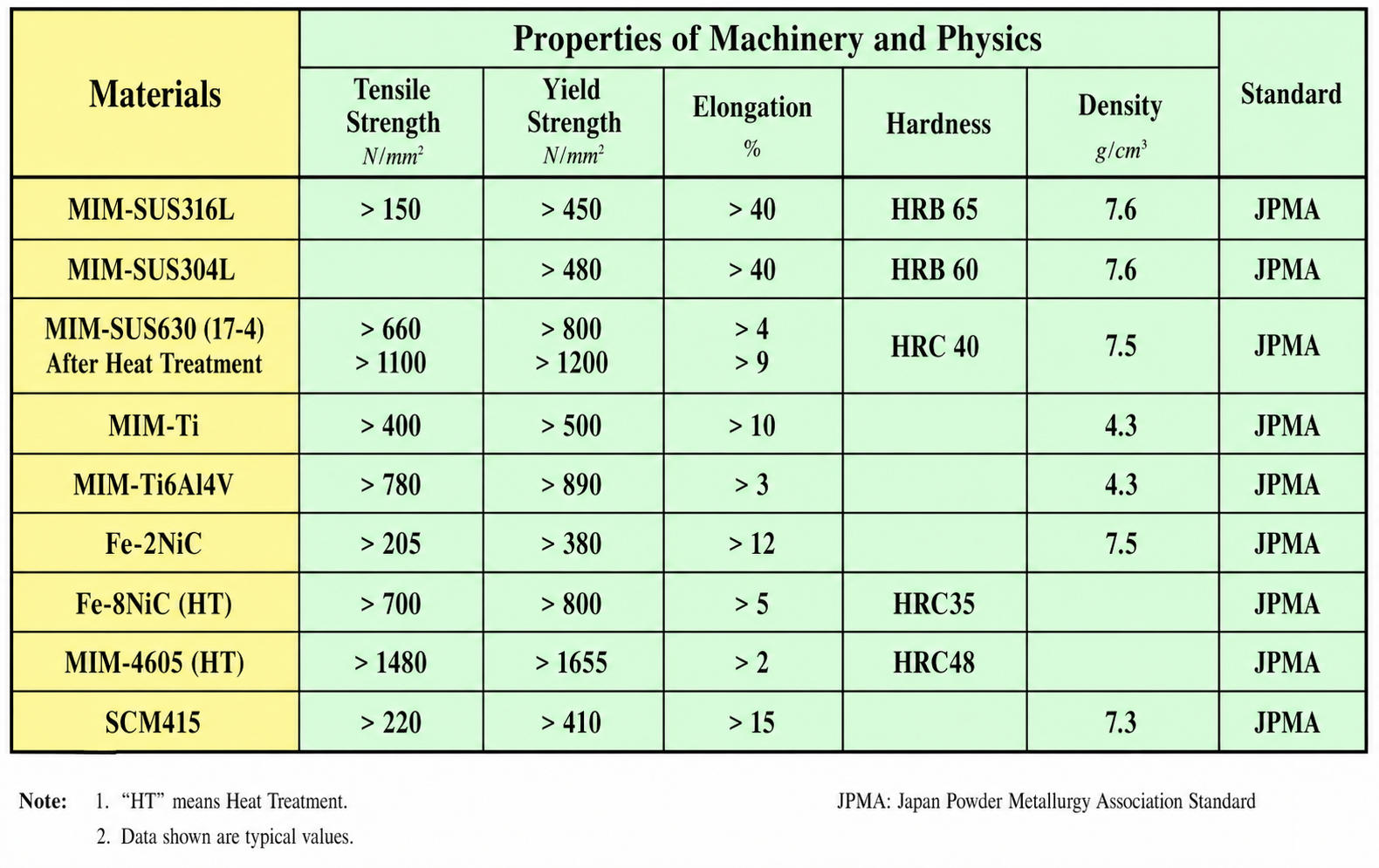
The material system for Metal Injection Molding (MIM) is extremely broad, ranging from highly corrosion-resistant stainless steels and high-hardness tool steels to magnetic materials and titanium alloys. After sintering, MIM parts typically reach 96% to 99% relative density. Their mechanical properties, such as tensile strength and fatigue strength, not only exceed those of investment castings, but can also be comparable to forged materials.
We provide the following four core material solution categories to meet the application needs of different industries:
1. Stainless Steels — The Mainstream Materials for MIM
Stainless steel is currently the most widely used material category in the MIM market, offering an excellent combination of appearance, corrosion resistance, and mechanical performance.
- 17-4PH, Precipitation-Hardening Stainless Steel
17-4PH is a flagship material in the MIM industry, combining high strength with good corrosion resistance. After heat treatment, such as H900, hardness can reach 40-45 HRC and tensile strength can exceed 1,100 MPa. It is widely used in golf club heads, surgical instruments, and high-strength structural components. - 316L, Austenitic Stainless Steel
316L offers excellent corrosion resistance and is a preferred material for medical implants, premium watch cases, and chemical components. Although it cannot be strengthened by heat treatment, it provides excellent elongation and is suitable for applications requiring high toughness. - 440C, Martensitic Stainless Steel
440C is designed for high hardness and wear resistance. After heat treatment, hardness can reach 58-60 HRC. It is commonly used in cutting tools and bearings.
2. Low Alloy Steels — Cost-Effective Options for Structural Components
When products primarily require structural strength and can allow surface rust-prevention treatments such as nickel plating or black oxide, low alloy steels are an excellent choice.
- Fe-2Ni / Fe-8Ni, Including 4605 and 8740 Grades
These iron-nickel alloy systems respond very well to heat treatment. After carburizing or quenching and tempering, they can achieve high surface hardness while maintaining core toughness, making them well suited for power tool gears, ratchets, and automotive components.
3. Tool Steels — Extreme Wear Resistance
SKD11 / D2 and M2
These materials are designed for extreme wear environments. They retain abundant carbides and provide very high hardness and red hardness after sintering. Typical applications include industrial sewing machine parts, nozzles, and mold inserts.
4. Specialty Alloys
Soft Magnetic Alloys, Such as Fe-Ni and Fe-Si
Materials such as 1J50 and 1J79 offer high magnetic permeability and low coercivity, making them ideal for electronic sensors, magnetic valve cores, and communication components.Titanium Alloy, Ti-6Al-4V
Ti-6Al-4V combines lightweight performance with biocompatibility, making it a key material for advanced medical and aerospace applications. However, it also requires the strictest control of the sintering environment.