
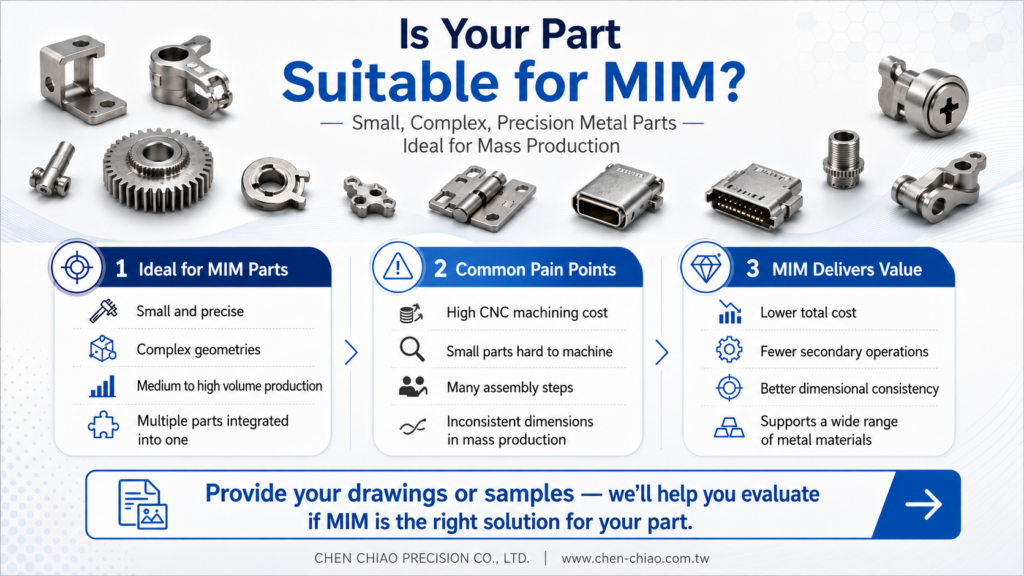
Quick Check: Is Your Part Suitable for MIM?
| Evaluation Criteria | Description |
|---|---|
| Small part size | Usually suitable for small precision metal parts |
| Complex geometry | Holes, grooves, curved surfaces, thin walls, and irregular structures |
| Long CNC machining time | If the process requires many machining steps or the tool is difficult to access, MIM has advantages |
| High annual demand | Suitable for medium- to high-volume production; tooling cost can be spread across production volume |
| Stable dimensional requirements | Mass production consistency is easier to control than traditional machining |
| Desire to reduce assembly | Multiple components can be integrated into one MIM part |
| Metal material required | Common MIM materials include stainless steel, low-alloy steel, and others |
What Customer Pain Points Can MIM Solve?
Pain Point 1: CNC machining cost is too high
Pain Point 2: Parts are small and difficult to machine or clamp
Pain Point 3: Multiple parts require welding, riveting, or assembly
Pain Point 4: Casting is too rough, while CNC is too expensive
Pain Point 5: Dimensional consistency after mass production is unstable