
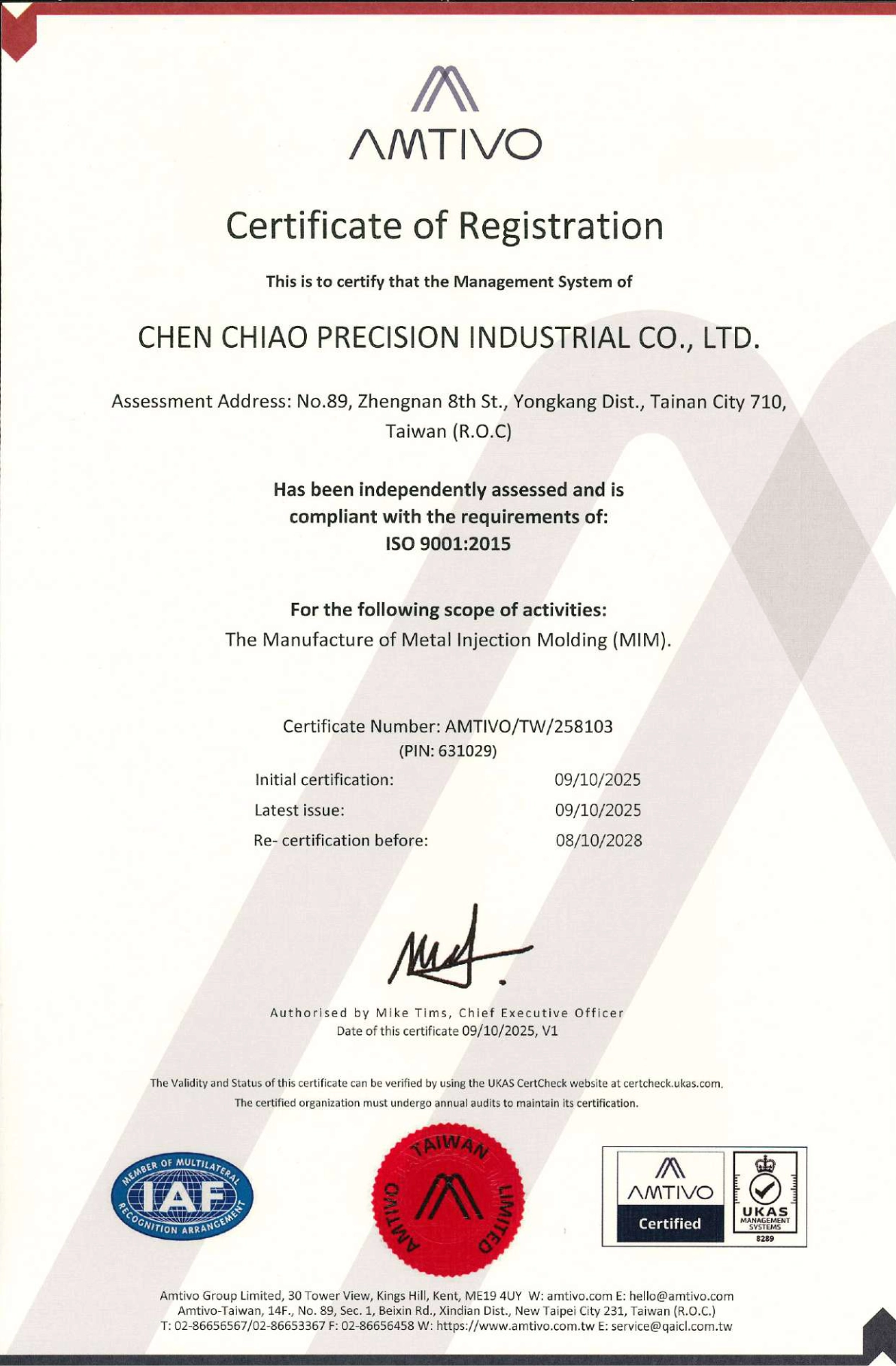
Built on the solid foundation of the ISO 9001 international quality management system, we have established a rigorous quality control process tailored to the specific characteristics of Metal Injection Molding (MIM), covering everything from raw material analysis to final product inspection. We understand the sensitivity of the MIM process: even small variations can affect final sintering shrinkage and mechanical performance. Therefore, we follow the engineering principle that prevention is better than correction, ensuring consistent quality in mass production.
Our quality assurance strategy covers four core areas:
1. Raw Material Rheology and Powder Monitoring

Quality begins at the source. We strictly inspect each batch of metal powder, including particle size distribution (PSD), tap density, and powder morphology analysis. For compounded feedstock, we use capillary rheometry to monitor melt flow behavior, ensuring stable filling during injection molding and preventing sintering deformation caused by density variation.
2. Green Part and In-Process Quality Control (IPQC)

During the injection molding stage, we use high-precision electronic scales to monitor green part weight. Weight variation is directly related to final dimensional shrinkage, and controlling weight variation within ±0.3% is a key prerequisite for achieving precision tolerances. We also strictly monitor debinding rates to prevent defects such as blistering or cracking caused by incomplete binder removal.
3. Metallurgical and Microstructure Analysis

Sintering is the key factor that determines the physical properties of the product. We are equipped with density testers, Rockwell/Vickers hardness testers, and metallographic microscopes.
Density Testing
We verify that relative density reaches more than 96% of theoretical density, which is a key assurance of high strength.Carbon Content Control
For materials such as 17-4PH and 316L, we use carbon-sulfur analyzers to strictly control carbon content, helping to avoid intergranular corrosion or insufficient strength.Metallographic Analysis
We examine grain size, pore distribution, and phase transformation to ensure there are no abnormal precipitates or structural defects.
4. Metrology and Functional Testing

To meet customers’ strict tolerance requirements, typically at the ISO 2768-m level, we use optical measuring instruments and dedicated inspection gauges for dimensional verification. Depending on the product application, we also perform tensile testing, salt spray testing, and torque testing to ensure that every shipped part meets engineering specifications.